ReCoop
Cooper Union's first in-house PLA Recycling System
Company/ Client
ReCoop Cooper Union
Role
Founder Project Manager Fundraiser
Skills
Sustainable Design 3D Printing Heat Transfer
Tools
Laser Cutter Water Jet Cutter
Duration
2022-2023

Overview
Driven by a commitment to sustainability and supported by Cooper Union and AACE Lab Project Grants, I designed and built an internal plastic recycling facility to manage 3D printer waste, benefiting all college departments and establishing Cooper as a local recycling hub.
As 3D printing grows, so does the plastic waste from failed prints. PLA, the most common filament, takes nearly a century to decompose, contributing to pollution and microplastics. Recycling this waste into reusable filament or plastic sheets addresses this issue. Cooper Union alone produces over 100kg of PLA waste, equivalent to the weight of 160 basketballs.
The Problem
Context: The Cooper Union is a college of three schools dedicated to teaching students art, architecture, and engineering alongside the ethics of sustainable design.
With papermaking and a metal foundry in the art school, a strong community of students and faculty who compost, and a heightened awareness of plastic usage in the school of engineering, Cooper is uniquely suited to successfully transition to a zero-waste campus. According to GrowNYC, New York City only recycles about 17% of its total waste, and exporting plastic waste costs taxpayers hundreds of millions of dollars annually. To continue the development of a strong culture of sustainability at Cooper, the next step is to build an in-house plastic recycling center.


Developing a Method for Sheets
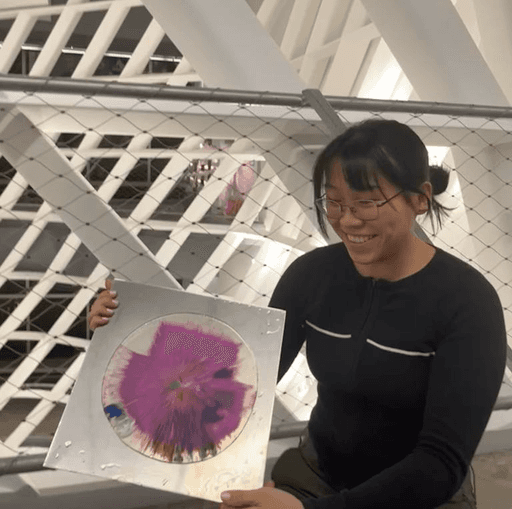
By Spring 2023, I was able to solidify methods for sheet pressing PLA rounds using a T-shirt press. I explored many temperature and timing settings, literature on PLA, and Instron testing to determine the perfect concoction of parameters for glassy PLA sheets.
In addition to the sheet pressing method, curious students and students from the ReCoop project enrolled in an independent study with Douglas Thornhill on the material properties of Poly Lactic Acid (PLA) to better understand its life cycle in terms of polymerization and decomposition and address potential safety concerns for the recycling system.

Mechanical Testing
After developing a repeatable method of generating PLA 1/8" sheets, I used the Instron machine to test the mechanical behavior of the sheets. I laser cut dog bones and performed tensile testing on dog bones composed of varying ratios of virgin PLA to shredded recycled PLA. The greater the fraction by weight of recycled PLA, the more brittle the sample.
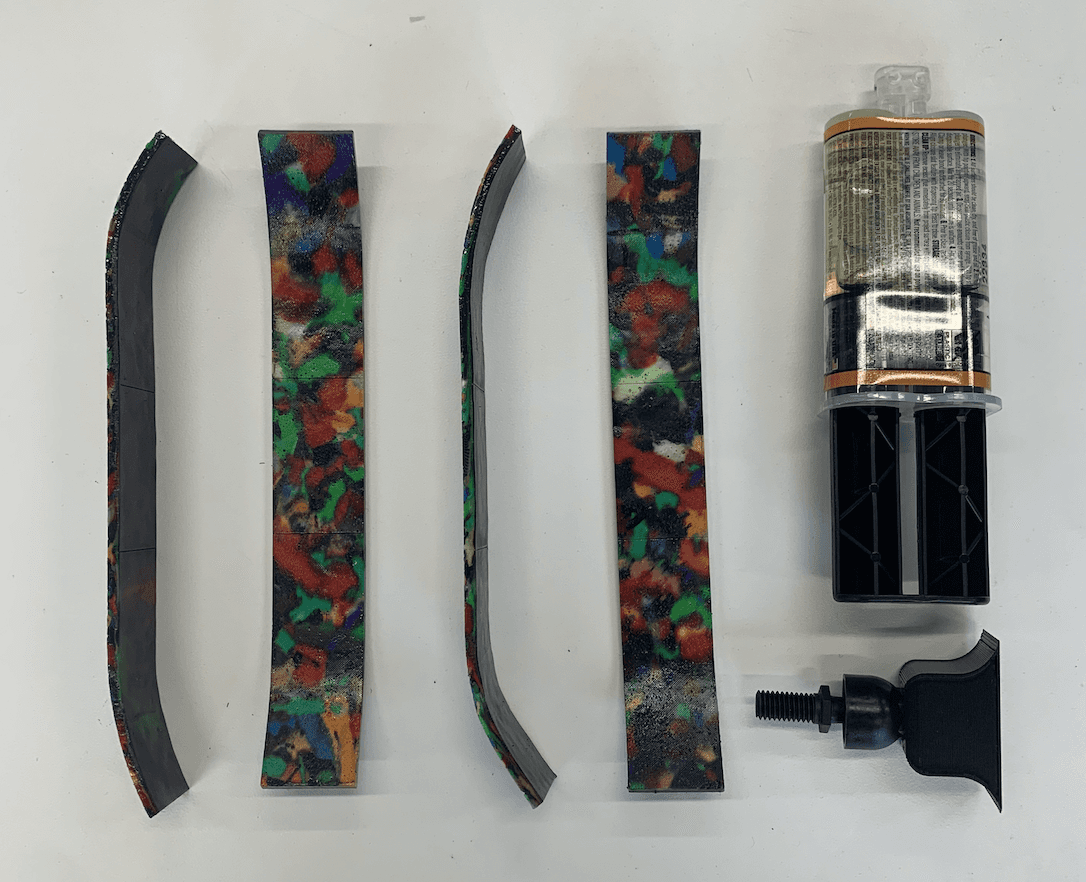
This mechanical data allowed me to develop sustainable, light weight, competition-grade VTOL drone landing gear for my senior capstone project


Conclusion
The ReCoop Project was something I dreamt of during my work at the AACE Lab alongside two good friends, Brandon Bunt and Daniel Luo. My senior year at Cooper was dedicated to making the idea a reality. The AACE Lab projects grant, Prof. Douglass Thornhill, and many other curious students were invaluable help. The project continues to grow and is part of the Cooper Summer Stem outreach program which teaches high school students about the science and value of recycling.
Landing Gear
Laser-cutting recycled PLA for VTOL drone landing gear

Web Design
Using HTML, CSS, and design tools for out reach

Poster Design
Creating posters in Adobe Suite
While my last year at Cooper flew by, I made sure that the team could learn and understand the material science behind PLA recycling before sheet pressing, extruding, and injection molding to ensure a well-thought-out recycling process.
In future semesters, ReCoop can grow to offer additional recycling methods and polish methods for using the injection and silicone molding processes. The ReCoop project will continue to help the Cooper community in its zero-waste initiatives and provide materials for future projects.